

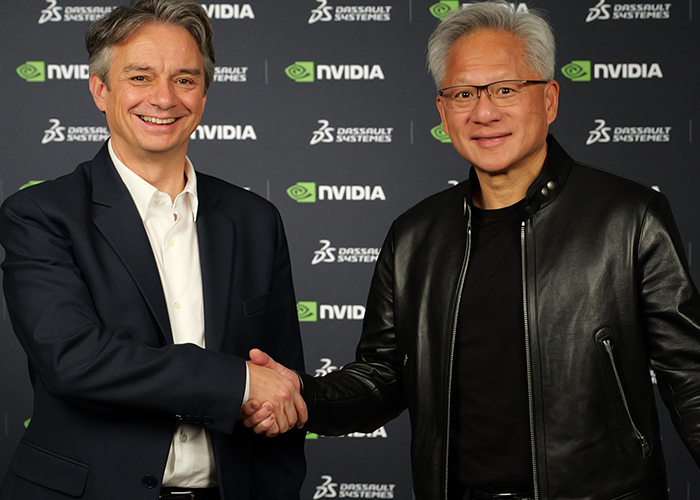
Dassault Systèmes and NVIDIA have announced a long-term strategic partnership aimed at creating a shared industrial AI platform that combines virtual twins with large-scale AI infrastructure, a move that could reshape how cities, industries and critical systems are designed and operated.
The collaboration brings together Dassault Systèmes’ virtual twin technologies with NVIDIA’s accelerated computing, AI infrastructure and software platforms to build what the companies describe as “science-validated world models” for industry. These models are intended to move industrial AI beyond isolated use cases and establish it as a mission-critical system of record for sectors ranging from manufacturing and energy to mobility, materials science and urban infrastructure.
The partners said the platform will enable a new way of working through so-called “skilled virtual companions” – AI agents embedded within Dassault Systèmes’ 3DEXPERIENCE platform that can operate with deep industrial and physical context, rather than relying purely on statistical prediction.
Pascal Daloz, chief executive of Dassault Systèmes, said the partnership reflects a shift in how artificial intelligence is being applied in real-world systems.
“We are entering an era where AI does not just predict or generate, but understands the real world,” Daloz said. “When AI is grounded in science, physics and validated industrial knowledge, it becomes a force multiplier. Together with NVIDIA, we are establishing a new foundation for industrial AI that can be trusted and scaled.”
NVIDIA founder and chief executive Jensen Huang said the collaboration aligns with the company’s focus on “physical AI” – systems that are governed by the laws of the physical world rather than abstract data alone.
“By uniting NVIDIA’s AI and Omniverse platforms with Dassault Systèmes’ industrial leadership, we are transforming how engineers, designers and researchers build the world’s most complex systems,” Huang said.
A key element of the partnership is infrastructure. Dassault Systèmes, through its OUTSCALE brand, is deploying AI factories as part of its sovereign and sustainable cloud strategy. These facilities will run on NVIDIA AI infrastructure across three continents, enabling AI models to be trained and operated within the 3DEXPERIENCE platform while maintaining data sovereignty, intellectual property protection and regulatory compliance.
At the same time, NVIDIA is adopting Dassault Systèmes’ model-based systems engineering to design its own AI factories, starting with the NVIDIA Rubin platform, and integrating this approach into large-scale AI factory blueprints within NVIDIA Omniverse.
The combined platform is intended to support a wide range of applications relevant to smart cities and industrial ecosystems. In materials science and biology, NVIDIA’s BioNeMo platform will be paired with Dassault Systèmes’ BIOVIA models to accelerate molecular and materials discovery. In engineering and infrastructure design, AI-enhanced virtual twin physics will allow faster and more accurate simulation of complex systems. In manufacturing, factory-scale virtual twins will support more autonomous, software-defined production environments.
For urban planners and smart city developers, the companies said the ability to model physical systems with validated digital twins – from transport networks and energy systems to advanced manufacturing hubs – could enable more resilient, efficient and sustainable decision-making.
Several global organisations are already working with the combined technologies. Food group Bel said the partnership will allow it to optimise products and packaging at scale while meeting sustainability targets. Automation company OMRON pointed to the potential for fully autonomous and digitally validated production systems. Automotive manufacturer Lucid highlighted faster iteration in vehicle and powertrain engineering, while aviation researchers at Wichita State University’s National Institute for Aviation Research cited benefits for certification-ready aircraft design.
Dassault Systèmes and NVIDIA said the partnership elevates their existing collaboration into a shared, long-term vision for industrial AI, one in which virtual twins, AI and accelerated computing form the backbone of how future cities, factories and critical infrastructure are conceived, tested and operated.
As governments and industries look to digital technologies to support smarter, more sustainable urban environments, the companies argue that grounding AI in physics-based, science-validated models will be essential to moving from experimentation to real-world impact at scale.