
The convergence of teleoperation and autonomy is taking a major step forward in Europe’s agricultural sector. MIRA GmbH, Rheinmetall Technology Centre (RTC), and Arnold NextG GmbH have joined forces to develop a teleoperated and autonomous tractor — a breakthrough innovation that could transform the way agricultural machinery operates in connected, data-driven environments.
The joint project focuses on creating a scalable platform powered by advanced drive-by-wire technology. This foundation enables both remote operation and autonomous functionality, bringing a new level of flexibility and safety to agricultural mobility.
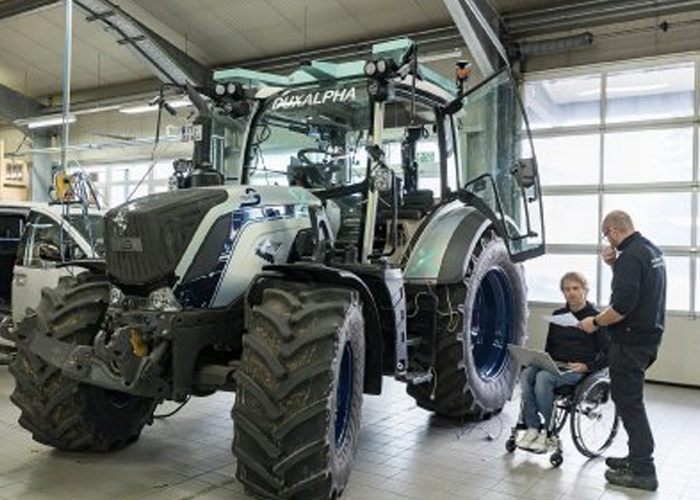
The prototype tractor (pictured) has been equipped with multiple sensors and high-resolution camera systems, integrating the NX NextMotion drive-by-wire system developed by Arnold NextG, along with the DuxAlpha 3D guidance system that enables autonomous field navigation. The result is a system capable of performing precision farming tasks autonomously in the field, while being teleoperated safely and efficiently on public roads.
For MIRA GmbH and Rheinmetall, this marks the first introduction of their teleoperation technologies into the agricultural sector — technologies previously proven in defence, industrial, and logistics applications. The collaboration aims to deliver systems that enable secure, long-distance remote control of heavy-duty agricultural vehicles, helping farmers manage operations from anywhere while maintaining high levels of accuracy and safety.
At the heart of this innovation lies drive-by-wire technology, which replaces traditional mechanical and hydraulic controls with fully electronic, redundant systems. This allows every vehicle function — from steering and braking to power management — to be controlled digitally, forming the basis for full autonomy and teleoperation.
“By combining teleoperation with autonomous control, we’re creating a system that brings together the best of both worlds,” said a project spokesperson. “Farmers gain the ability to operate equipment remotely during hazardous or time-sensitive conditions, while also leveraging autonomous operation for repetitive fieldwork. It’s the next logical step in the digital transformation of agriculture.”
The collaboration between MIRA, Rheinmetall, and Arnold NextG reflects a broader shift in smart mobility — one where connectivity, autonomy, and safety converge to improve sustainability and efficiency. In a world where cities, industries, and rural operations are increasingly interconnected, such technologies are key to building resilient, adaptive systems that can respond to environmental and operational challenges.
Beyond agriculture, the project’s scalable platform concept points to wider applications across smart infrastructure and logistics. Drive-by-wire architectures are already central to emerging smart city ecosystems, where remote monitoring, predictive maintenance, and autonomous coordination between vehicles and infrastructure are becoming essential.
As the agriculture sector embraces automation and digital transformation, the teleoperated tractor is a tangible example of how smart technologies are reshaping traditional industries. From connected tractors in rural fields to intelligent vehicles navigating urban landscapes, the fusion of autonomy and teleoperation marks a defining step toward the fully integrated, adaptive mobility systems of the future.