

A new way to imprint complex surfaces on low-cost, sustainable polymers could be used in a wide range of industries, including for water-repellent coatings, optical devices and data storage discs.
The complex nano- and micro-scale patterns on sulfur-derived polymers, unveiled this week in the American Chemical Society ACS Applied Materials and Interfaces journal, build on a wide range of green chemistry solutions led by Flinders University.
“This discovery provides a way to create these technically challenging and time-consuming patterns which can be useful to repel water, prevent biofilm formation and manipulate light in optics applications,” says senior author ARC Future Fellow Professor Justin Chalker, a global leader in sulfur chemistry.
“Our team invented a one-step method to make complex patterns on low-cost polymer surfaces using laser light energy without the need for expensive materials.
“Installing different patterns on the polymer surface can have multiple applications – for example, using water-repellent materials in self-cleaning, anti-fouling and anti-icing surfaces.”
Lead author Dr Abigail Mann, from the Chalker Lab at Flinders University, says using low-power lasers to create these surfaces is an exciting development.
“It opens up the possibility of using these intricate polymer surfaces in a wide range of high-value applications,” says Dr Mann, whose PhD focused on the discovery of creating high-density data storage on polymers made in the inverse vulcanisation process.
Senior co-author Dr Christopher Gibson says the modification of polysulphide surfaces with low-power lasers could also support advances in electronics, information storage, biomedical devices, microfluidics and other applications – plus patterns to interact with light and reflect a range of iridescent colours for optics and anti-counterfeiting devices.
“Without this research group, the accidental discovery I made during routine analysis of the polymer surface at Flinders University would have remained an interesting footnote, rather than becoming the focus of a series of breakthrough studies,” says Dr Gibson, director of Adelaide Microscopy in South Australia.
The latest trials of microscale patterns on the otherwise black surface of a low-cost sulfur-derived polymer has enabled the creation of structural colour, similar to the iridescent colours observed in butterfly wings and peacock feathers. In anti-counterfeiting devices, this complex pattern could serve as a hidden bar code that can be read with collimated light projected at certain angles.
In the new study, Professor of Physical Chemistry Chiara Neto and other University of Sydney researchers provided expertise in adding nano-texturing, in an aim to create ‘superhydrophobic’ water-repellent surfaces which often require perfluorinated materials linked to the production of harmful PFAS in their manufacture and use.
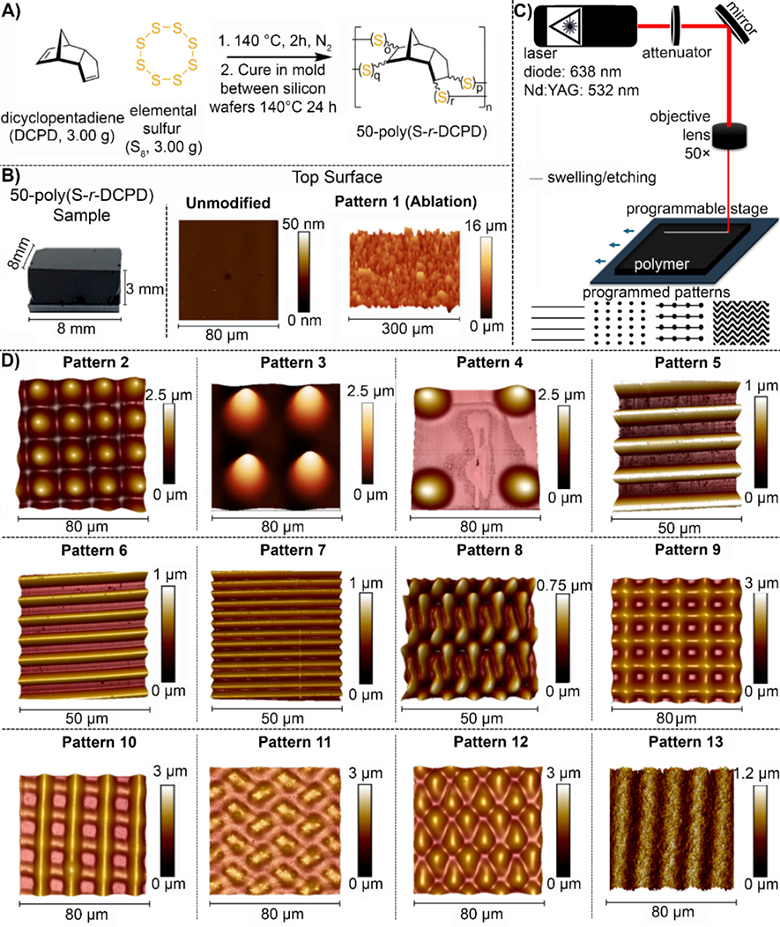
ABOVE (Fig 1): The polymer, made from abundant and inexpensive sulfur from petroleum refining and dicyclopentadiene, is ultra-sensitive to low-power lasers of approximately 1 mW – weaker than a typical laser pointer.
Very short exposure times to this low-energy laser light caused swelling in the polymer – something not usually observed with other common polymers or plastics.
Researchers then found the swelling could be controlled, with the size and shape of the modification directly related to the laser exposure time – and the modification was highly stable, persisting for months to years.
This discovery prompted the team to develop a programmable laser system to trace complex patterns on the polymer, installing dots, lines, grids and even exotic patterns that mimic the structure of shark skin.
The article, ‘Direct photopatterning on polysulfide polymers for engineered surfaces and anti-counterfeiting technology’ (2026) by Abigail K Mann, Leo James, Harshal D Patel, Iliana Delcheva, Melanie MacGregor, Sara J Fraser-Miller, Jason R Gascooke, Pankaj Sharma, Chiara Neto, Christopher T Gibson and Justin M Chalker has been published in ACS Applied Materials and Interfaces. DOI: 10.1021/acsami.6c08290.
Acknowledgements: Funding for this research was provided by the Australian Research Council (FT200100301, FT220100054, DP230100587, DP230100555, DP240102137 and DP260100466). The instrumentation available through Flinders Microscopy and Microanalysis facility, supported by NCRIS facilities such as the Australian National Fabrication Facility (ANFF) and Microscopy Australia, were crucial to characterise and apply this polymer modification.