

Flinders University researchers say they have developed an aqueous zinc-iodine rechargeable battery design aimed at improving sustainability and cycle life as demand for lithium-ion batteries continues to rise.
In a study published in Angewandte Chemie, the team reports an aqueous zinc-iodine battery (AZIB) capable of being charged and discharged over 60,000 cycles. The researchers describe the work as targeting large-scale energy storage applications, where cost, safety and supply-chain constraints are increasingly under scrutiny.
“Rechargeable aqueous zinc-iodine batteries are shaping up as a viable alternative to popular lithium-ion batteries for large-scale energy storage and our group is now working with industry to establish a prototyping platform for this alternative battery system,” says Associate Professor in Chemistry Zhongfan Jia, Matthew Flinders Fellow at Flinders University’s College of Science and Engineering.
According to the release, iodine has the potential to store about 211 mAh/g (milliampere-hours per gram), but the technology faces challenges in preventing iodine species from migrating within the battery and reducing performance.
The study describes the use of a cyclodextrin-based polymer intended to help store and control iodine-related chemicals. The researchers report that when fully charged in seven minutes, the battery can operate at 1.3 to 1.4 volts with a capacity of 200 mAh/g over 8000 cycles, or when charged in three minutes, deliver more than 60,000 cycles at 150 mAh/g.
“This system offers a new approach to mitigate polyiodide shuttling by using polymers derived from inexpensive, biodegradable materials, thereby enabling sustainable and long-lasting aqueous zinc-iodine batteries,” says Associate Professor Jia.
The release frames the work against growing concerns about lithium-ion battery supply and waste. It cites Australian government projections that Australia produces about 3300 tonnes of lithium-ion battery waste annually, expected to rise to more than 136,000 tonnes by 2036.
The researchers also point to zinc as a lower-cost, widely available metal, noting Australia holds the world’s largest known zinc reserves, estimated at 20% to 28% of global totals.
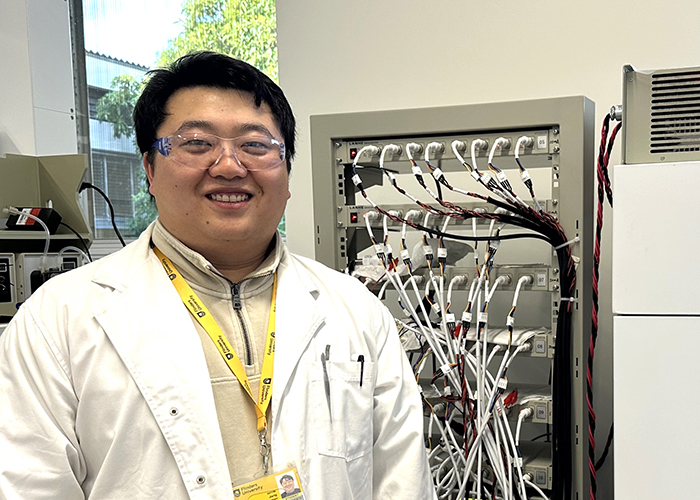
“As a top global producer and exporter, we can use these zinc resources for safer energy storage, which is important for energy manufacturing in Australia,” says first co-author Shangxu Jiang, a PhD student at Flinders University’s Jia Lab.
Second first author Zhipeng Pei worked with senior co-author Professor Michelle Coote on computational modelling supporting the project, the university said.
The paper, titled ‘Caging polyhalide anions in polycyclodextrin for long-lasting aqueous zinc-iodine batteries’ (2026), lists authors Shangxu Jiang, Zhipeng Pei, Yanlin Shi, Kai Zhang, Justin M Chalker, Sara J Fraser-Miller, Michelle L Coote and Zhongfan Jia, and is published in Angewandte Chemie International Edition (Wiley) with DOI: 10.1002/anie.601068.
The project was funded by Australian Research Council grants (DP230100587, DP230100642, DP260100462, DP230100555 and CE230100021), with support from the National Facility of the Australian National Computational Infrastructure and Flinders Deepthought, as well as the Flinders University High Impact Collaborative Research Development Fund, YG Green Power Superstore and Zhejiang Sci-Tech University, according to the acknowledgements.
The authors also acknowledged Flinders Microscopy and Microanalysis and the Australian National Fabrication Facility SA node for technical support and equipment.