

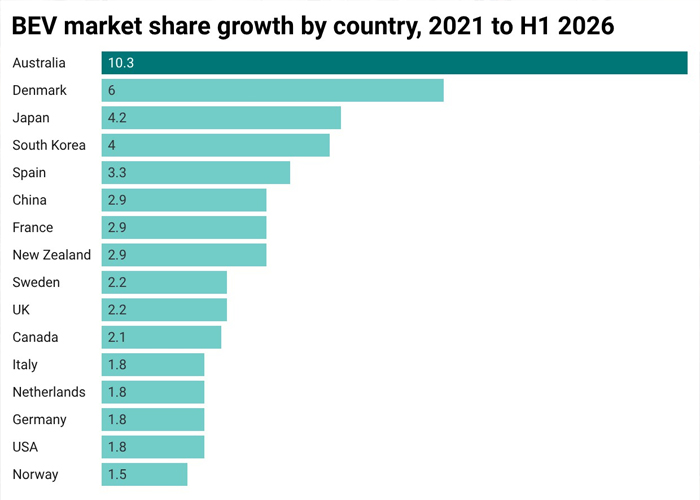
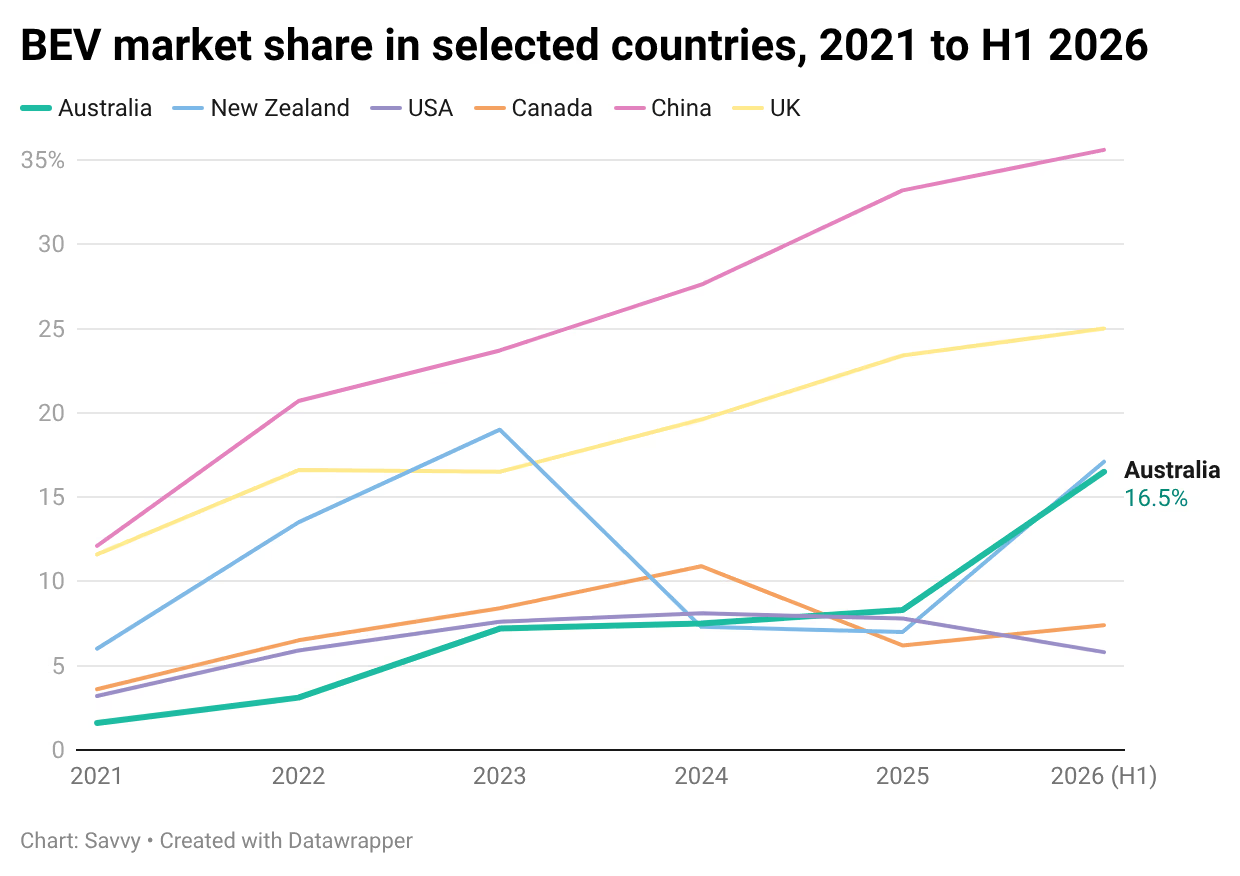
Australia has moved from one of the slowest electric vehicle adopters to one of the fastest-growing markets, with battery electric vehicles (BEVs) accounting for 16.5% of new vehicle sales in the first half of 2026, according to figures cited in a media release from car loan provider Savvy.
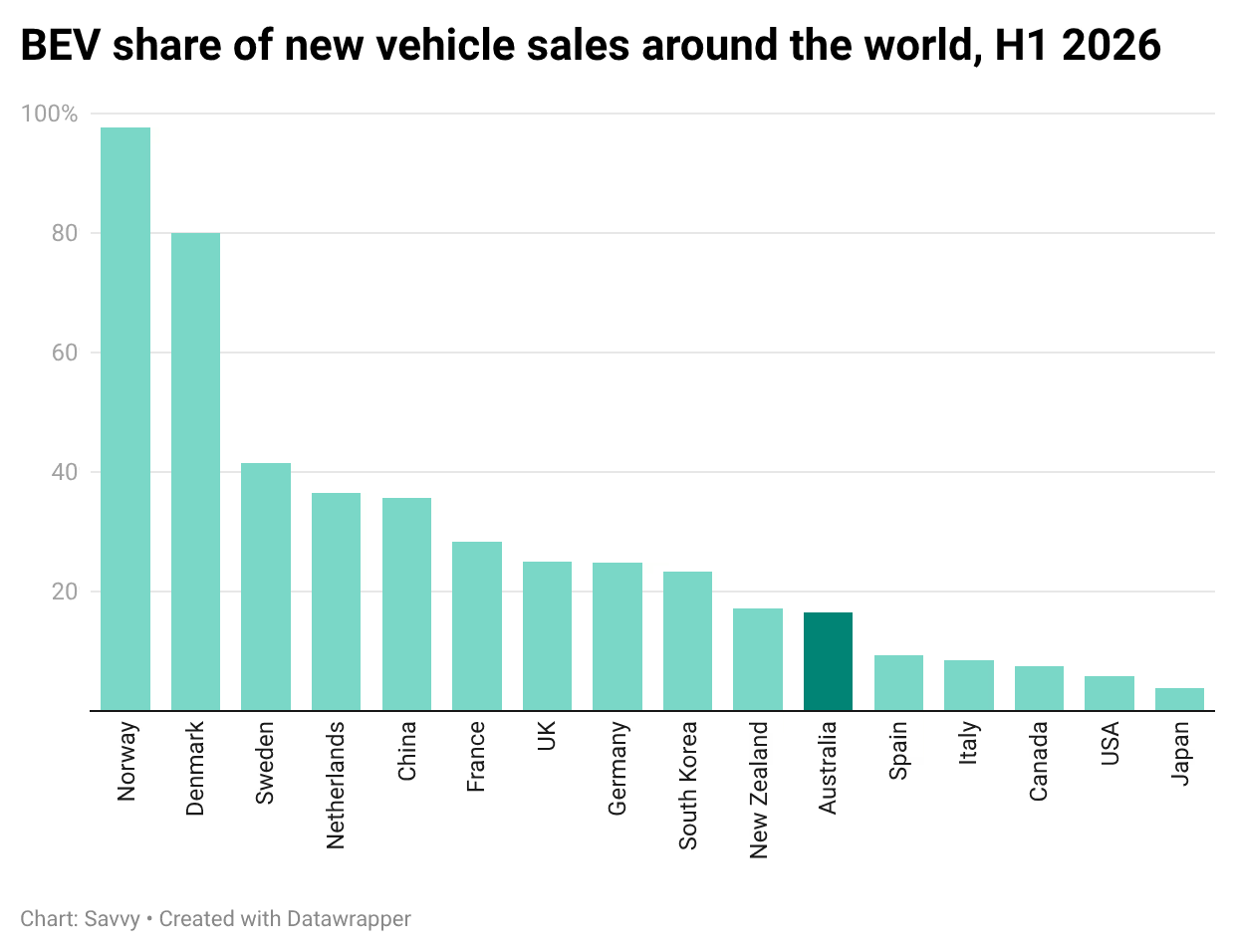
The release said Australia’s BEV share has risen from 1.6% in 2021 to 16.5% in H1 2026, representing the fastest relative growth among 16 countries analysed for the period. New Zealand was slightly ahead at 17.1%, while Norway led the group at 97.6%.
It also claimed BEVs now hold a larger market share in Australia than in the US, Canada, Japan, Spain and Italy.
The media release attributed part of the shift to the growing availability of lower-cost Chinese EVs, naming BYD, Chery, Geely, MG, Jaecoo and Zeekr. It quoted BYD Australia Chief Operating Officer Stephen Collins as saying: “Chinese car brands went from zero to 20% market share in five years.”
According to the release, BYD overtook Tesla as Australia’s biggest-selling EV brand in the first half of 2026. It also said the BYD Atto 1 recently became Australia’s cheapest new car at $19,990 driveaway.
High petrol prices and government policy were also cited as factors supporting adoption, although the release pointed to charging access as a continuing barrier for renters and apartment residents. Savvy said its EV Sentiments Survey found 58% of apartment owners reported they could not install a home charger.
Savvy Managing Director Bill Tsouvalas said: “Australia’s EV uptake since March has blown everything open.
“We’ve recently opened our first car dealership and are aiming to stock it with as many used EVs as possible. There will still be a place for petrol and diesel vehicles, especially in the used market, but at the moment we’re seeing families desperately wanting to add an EV to the family garage.”
The sales shift has implications for infrastructure and policy, with increased demand for public and shared charging likely to intensify pressure on strata rules, grid planning and charging rollout in higher-density housing.