

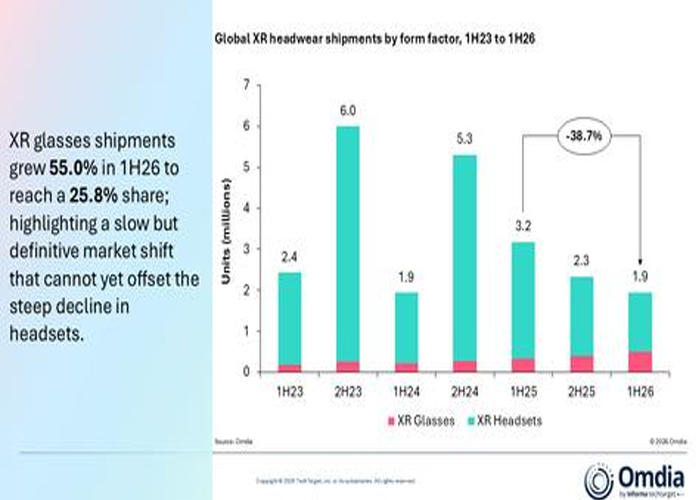
Global shipments of extended reality (XR) headwear fell 38.7% year-on-year to 1.9 million units in the first half of 2026, according to new data from technology research firm Omdia.
Omdia said growth in XR glasses was not enough to offset a sharp decline in XR headset shipments. The firm added that by 2025 the market had recorded its fourth consecutive year of decline following a pandemic-driven peak in 2021.
XR glasses increased their share of total XR headwear shipments to 25.8% in 1H26, up from 10.2% in 1H25, Omdia said. The increase was largely attributed to tethered display glasses, with RayNeo, VITURE and XREAL together taking 93.1% of that segment.
Omdia said demand for devices including the RayNeo Air 4 and VITURE Beast series lifted RayNeo and VITURE to second and third place in the overall XR headwear market, with shipment shares of 9.9% and 8.6% respectively.
“XR glasses are gaining momentum because consumers are increasingly willing to trade some immersion for less friction,” said Qiran Ju, Senior Analyst at Omdia. “Lighter designs and familiar use cases such as video viewing and gaming are lowering the barriers to adoption.”
Meta retained the overall market lead, but its share fell from 71.3% in 1H25 to 48.2% in 1H26 as demand for the Meta Quest 3 and 3S weakened, Omdia said.
“Meta poured massive resources into headsets, but has struggled to replicate the breakout success of the Quest 2,” said George Jijiashvili, Senior Principal Analyst at Omdia. “Despite the Quest 3 and 3S offering better specs at accessible prices, they have failed to drive a major upgrade cycle or meaningfully expand the audience. The ongoing slump across the headset market reinforces that bulky headwear remains a tough sell beyond a core enthusiast base.”
Regionally, North America remained the largest XR headwear market with a 43.9% shipment share in 1H26, followed by Western Europe at 23.8%, Omdia said.
Greater China recorded the largest increase in global shipment share, rising from 11.9% in 2025 to 16.3% in 1H26, overtaking Rest of Asia-Pacific as the third-largest regional market. Omdia attributed the shift to domestic uptake of tethered glasses.
“The next phase of XR evolution will be less about requiring people to enter isolated virtual environments, and more about embedding AI and spatial capabilities naturally into everyday wear,” Jijiashvili said. “Moving away from occasional, closed-off sessions to frequent, light-touch interactions will be the key to breaking out of the current enthusiast niche.”