

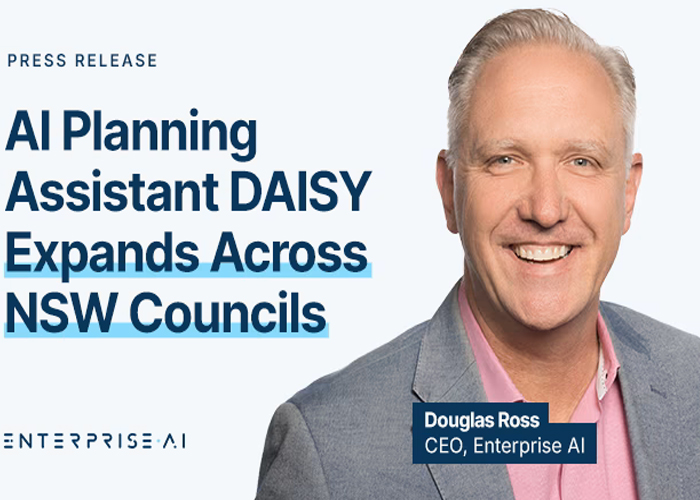
NSW local councils in the Hunter region are expanding use of an AI-based planning assistant to help residents and small developers navigate development application requirements, as the state looks to speed up approvals and increase housing supply.
City of Newcastle and Muswellbrook Shire Council are the latest councils to adopt DAISY (Development Application Intelligence System), an AI-powered planning assistant developed by Enterprise AI with transformation support from ADAPTOVATE. The companies say DAISY has recorded more than 16,500 conversations across NSW council deployments over nine months.
According to Enterprise AI reporting, DAISY logged 16,533 conversations between January and September 2026 across live council deployments, with around one-third of enquiries occurring outside traditional council counter hours. Enterprise AI modelling estimates those conversations equate to 4,133 hours of staff time returned, based on a 15-minute average handling time for comparable phone or counter enquiries.
The rollout comes amid broader NSW Government efforts to apply technology to planning processes. The release notes the NSW Government launched an initiative in September 2025 to introduce AI into the assessment of state significant development applications, and says DAISY was live in NSW under the Government’s Early Adopters Program at that time.
The announcement also points to housing supply pressures. Citing the Urban Development Institute of Australia NSW (UDIA NSW), it says NSW delivered 91,300 new homes in the first two years of the National Housing Accord, 59,500 short of the target, and that UDIA NSW forecasts the state could fall 150,000 homes short of its five-year target based on current trends.
DAISY is positioned as a tool to reduce friction in the development pipeline by providing guidance on which planning rules apply to a property, identifying required documentation and helping applicants check materials before lodgement. Dungog Shire Council is listed as the next Hunter council scheduled to go live with DAISY.
Douglas Ross, CEO at Enterprise AI, said the housing debate needed to look beyond formal policy settings to day-to-day barriers in the application process.
“Planning reform is an important part of addressing Australia’s housing challenge, but policy alone cannot solve every problem in the development pipeline. The experience of navigating the system matters, too,” Ross said.
“For a homeowner planning an extension or a small builder preparing a development application, understanding the rules and getting the paperwork right can be a significant hurdle. For councils, every incomplete application or avoidable enquiry adds to the workload of teams already managing complex assessments.
“AI creates an opportunity to improve that experience at both ends, helping people understand what they need to submit, while giving council teams more capacity to focus on the work that requires their professional expertise. These are practical changes, but at scale, making the process work better matters.”
Beyond resident-facing guidance, the companies say councils are exploring AI support for planning teams during assessment. Muswellbrook Shire Council is investigating a next stage of DAISY intended to support planners as part of the assessment workflow.
The release also references a partnership announced in May 2026 between Enterprise AI and local government software provider Civica to integrate DAISY into Civica Altitude. The integration combines DAISY Assist, aimed at guiding applicants through requirements, with DAISY Assess, which the companies say supports planners with compliance checks, interpretation of planning controls and report drafting.
The companies claim early adopters of DAISY have recorded a 20% reduction in assessment timeframes and a 49% increase in service capacity.
“Providing residents with better guidance is one part of the opportunity. The next is looking at how AI can support the work that happens behind the scenes, from checking applications against planning controls to helping planners prepare assessment reports.”
He continues, “The aim is not to automate planning decisions, but to give council teams practical tools that can help them work through information more efficiently, so their expertise can remain focused on the judgement and decisions that matter most.”