

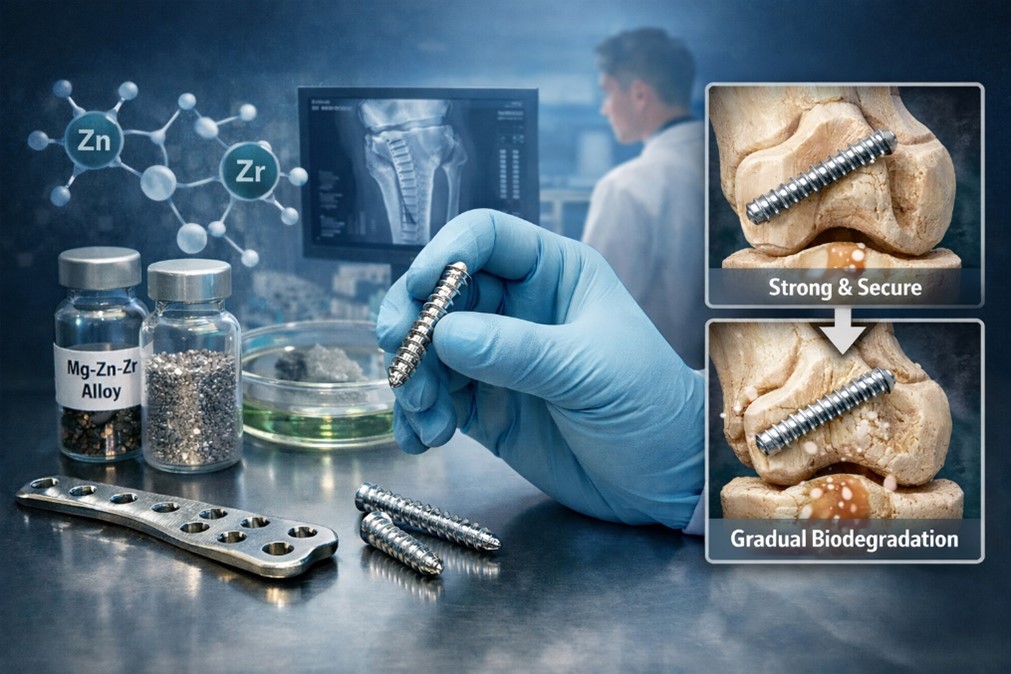
Flinders University researchers have developed a new class of biodegradable magnesium-based alloys designed to improve strength and corrosion resistance for medical implants, in work aimed at reducing the need for follow-up surgeries.
The study, published in Emergent Materials, examines how adjusting alloy composition—particularly by adding elements such as zinc and zirconium—can produce materials intended to better match the mechanical properties of human bone while improving durability in biological environments.
“These new alloys not only improve mechanical performance but also enhance corrosion resistance which is critical for implants designed to safely degrade inside the body over time” says Dr Reza Hashemi, a Senior Lecturer in Mechanical Engineering at Flinders University’s College of Science and Engineering.
“By refining the microstructure of the material, we were able to control how quickly the alloy breaks down, reducing the risks associated with premature degradation or loss of structural integrity.
“This balance between strength and controlled biodegradability is a key step toward safer, more reliable implant technologies.”
The findings are based on research led by Master of Mechanical Engineering graduate Win Ken Look. The university says the work contributes to efforts in advanced biomaterials to develop implants that dissolve after healing, potentially avoiding additional procedures to remove hardware.
The research paper is titled Effect of zinc and zirconium on the microstructure, mechanical properties and corrosion resistance of Mg-xZn-yZr-1Y alloys for biomedical applications (2026) by Win K Look, Lisseth KR Antolinez, Mohsen Feyzi, Wenlong Xiao and Reza Hashemi, published in Emergent Materials. https://doi.org/10.1007/s42247-026-01332-8
The study was supported by Microscopy Australia and the Australian National Fabrication Facility (ANFF) under the NCRIS at the SA Regional Facility, Flinders Microscopy and Microanalysis. The authors also acknowledged Associate Professor Wenlong Xiao at Beihang University for fabricating the magnesium alloys used in the research, and noted financial support through the Beijing Municipal Natural Science Foundation General Program (No. 7232084).