
Researchers at Adelaide University have successfully tested a portable optical atomic clock at sea, in what they say is the first maritime demonstration of a laser-cooled optical atomic clock.
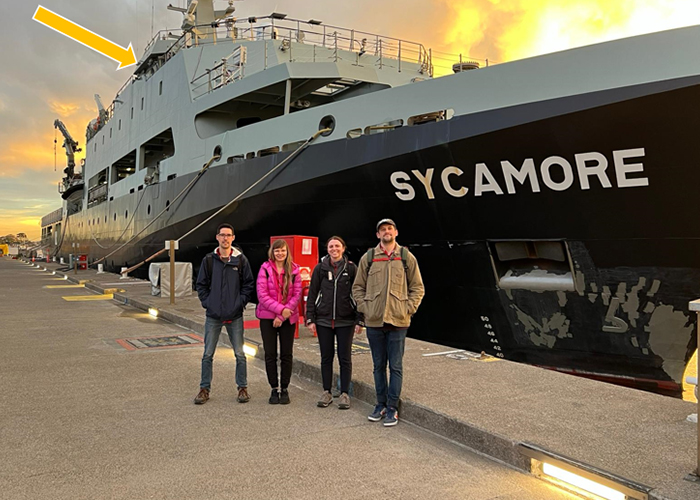
The team, from the university’s Institute for Photonics and Advanced Sensing (IPAS), developed the device and trialled it aboard a Royal Australian Navy vessel in July 2024. The results were reported in a paper published in Optica.
Atomic clocks provide highly accurate timekeeping that underpins technologies including GPS navigation, telecommunications networks and radio astronomy. However, high-performance systems typically operate in controlled laboratory environments and have not generally been designed for transport or operation in harsh field conditions.
The Adelaide University device is a portable optical atomic clock that uses laser-cooled ytterbium atoms. By cooling the atoms with lasers and measuring an atomic transition, the clock can track time more precisely than conventional systems.
According to IPAS Chief Innovator and project lead Professor André Luiten, the aim was to translate laboratory-grade performance into a system that can operate outside a lab. “Until now, the most precise clocks have largely been confined to specialised labs. Our work shows that this kind of performance can be achieved in a portable system that operates outside the laboratory,” he said.
During the trial, the clock was transported from the laboratory, installed on the naval vessel, and operated continuously for several days at sea. The researchers said the system maintained the same level of performance observed during laboratory testing despite vibration, movement and temperature changes.
Portable atomic clocks are drawing interest for potential applications including navigation systems that can function when satellite signals are unavailable or disrupted, improved synchronisation for telecommunications networks, and scientific uses such as radio astronomy that depend on precise timing.
The work was supported by the Defence Science and Technology Group and funded through the Australian Government’s Next Generation Technology Fund, now managed by the Advanced Strategic Capabilities Accelerator.
The researchers said they are continuing to refine the technology and plan additional field deployments, with the aim of making portable ultra-precise clocks available for scientific, commercial and defence applications.
The paper, ‘A portable laser-cooled ytterbium beam clock based on an ultra-narrow optical transition’, is published in Optica (DOI: 10.1364/OPTICA.584095).