
New research from Flinders University suggests augmented reality (AR) smart glasses can increase student engagement and support science learning in early primary classrooms when combined with group work and other activities.
The study trialled an “Immersive Visual Learning Environment” (AR-IVLE) with 84 Year 1 and 2 students and five teachers at a Victorian primary school. According to the researchers, the classroom program combined AR smart glasses with iPad exercises and other class activities, and was assessed for its impact on student engagement and behaviour.
The research team included education academics from Flinders University, Australian Catholic University and Zhejiang Normal University in China. Lead author Professor Gretchen Geng said the AR glasses could provide real-time, adaptive feedback aligned with individual learning preferences.
In the trial, the AR glasses were synchronised with iPads and Apple TVs so that digital content could be viewed by the group, aiming to support collaboration between students and teachers. The lesson content used a virtual ant nest to teach concepts that the researchers said can be difficult for young children to learn in traditional classroom settings.
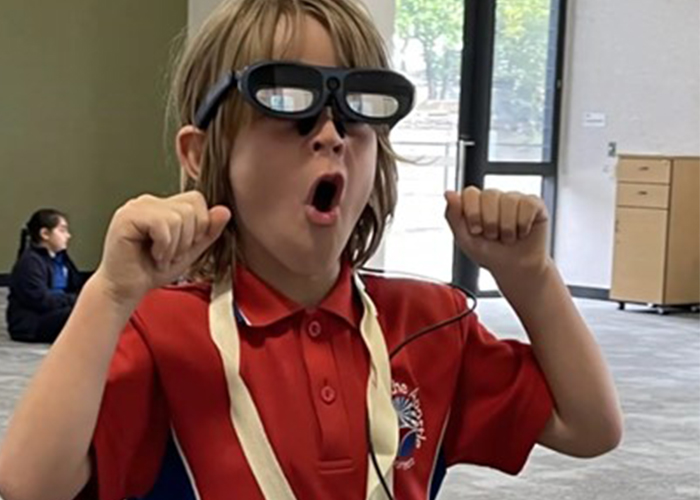
Students took turns using the smart glasses for around five to seven minutes under teacher supervision, while classmates followed the activity via an iPad display. The researchers said students wearing the glasses could move around the room and view virtual objects from different angles, using gestures to zoom and interact, while other students communicated directions and observations about the virtual ant colony.
The researchers reported higher engagement in the AR activity compared with students using iPads or tablets, along with improved learning outcomes and increased social engagement when AR was used alongside shared classroom screens. The release also said students demonstrated deeper understanding, richer ideas and stronger problem-solving skills through their work and reflections.
The findings were published in the Journal of Science Education and Technology in an article titled “Engaging Young Minds: How Smart Augmented Reality Glasses Transform Learning Experiences in AR smart glasses Immersive Virtual Learning Environments (AR smart glasses IVLE”, with co-authors from Australian Catholic University and Zhejiang Normal University.
The researchers said further multisite studies across different early childhood settings and socio-economic contexts could be used to validate and extend the findings, and that longer-term studies with reduced researcher involvement are needed to distinguish novelty effects from sustained engagement.
The release said the research received ethical clearance from Australian Catholic University (Ethics application: 2023-3299H), and that consent was obtained from participants, including children and parents. It also noted that the technology company ROKID loaned six pairs of AR smart glasses and developed AR teaching resources for the project.