

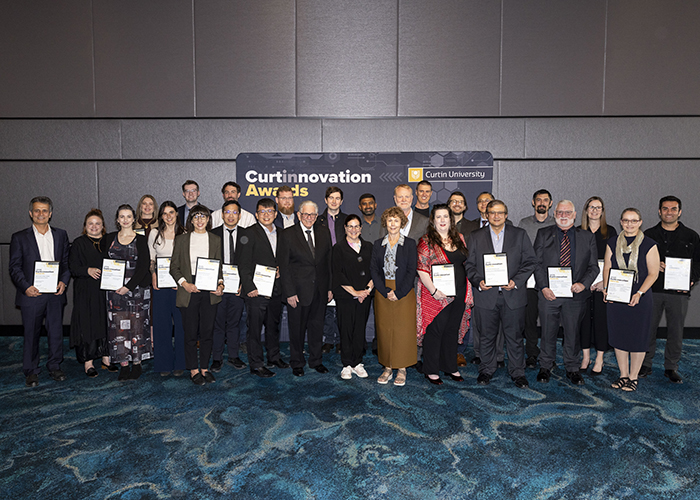
A seed-coating technology designed to improve crop yields while reducing fertiliser use has been named the overall winner of Curtin University’s 2026 Curtinnovation Awards.
The innovation, called Rhizobacterial Enhanced Seeds, was developed by Curtin researchers Dr Mohammad Farzam and Dr Rebecca Swift and received the Griffith Hack Overall Award. The technology coats beneficial bacteria onto seeds to support plant growth and reduce reliance on fertilisers, with Curtin citing lower costs and environmental benefits as potential outcomes.
The annual Curtinnovation Awards recognise Curtin-led innovations and researchers with commercial and community applications. Curtin said this year’s winners span health, agriculture, education, artificial intelligence, sustainability, mining and space technologies.
Curtin University Vice-Chancellor Professor Harlene Hayne said the winning seed technology addressed a major challenge for agricultural producers.
“As global demand for food continues to grow, farmers are under increasing pressure to improve productivity while reducing environmental impacts,” Professor Hayne said.
“The novel seed coating demonstrates how innovative research can help address that challenge. We’re also looking at its application in related fields, such as promoting the growth of native plant species in mine site rehabilitation.
“The Curtinnovation Awards celebrate the ideas and people helping solve real-world problems, and this year’s winners showcase Curtin’s ability to deliver solutions with meaningful economic, environmental and social benefits.”
Other award recipients included TBIScan, a portable device that uses brain activity measurements to support faster concussion assessments in clinical and sporting settings, and ASTRAPOD, an onboard navigation system designed to enable small satellites to determine precise real-time orbits autonomously.
Curtin also recognised Rivertown, a simulation game aimed at helping communities and governments prepare for flood risk, and Sunfish Robotics, a solar-powered underwater robot designed to collect ocean data for extended periods.
Additional category winners listed by Curtin included EngageMind, an AI platform aimed at supporting violence prevention by connecting at-risk individuals with services; PROsectionXR, a virtual dissection platform for anatomy learning; a geospatial tool for automated detection of drill rig GPS calibration drift; and Ai-MASS, an automated microalgae harvesting system using bio-based separation and AI monitoring.